mask
Unknown artist
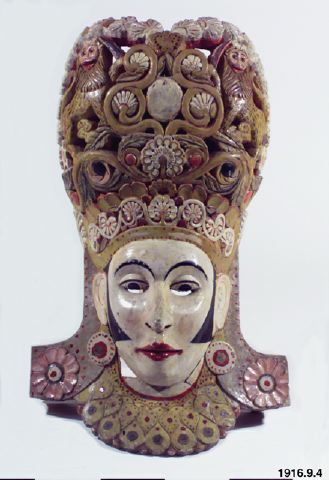
1916.9.04 Name and identification of character The mask reveals combined features of a king and a queen, and cannot be identified with certainty. The mask probably depicts King Maha Sammata or Queen Maha Sammata. Context King Maha Sammata and Queen Maha Sammata are the main characters appearing in stage two in Kolam performances, as part of the royal entourage. According to the verse texts retailing the origin of Kolam, the masked dances were enacted to entertain this royal couple. Material Wood, vel-kaduru (Sin.) (Nux vomica). Iconography Special attributes represented on the mask reveal combined features of a king and a queen. The head-dress is a crown, although it lacks the usual three tiers common to Kandyan crowns of kings. The sculptural details of the crown resemble the exquisitely ornamented crowns of queens. The face, however, retains male characteristics; the sidewhiskers are male. The crown is in the shape of a head-dress worn by an English queen, but the two lion figures carved on it are an ideogram of identification of Kandyan kings. The crown is covered with traditional Kandyan art designs comprising foliage, petals, dots and frets. The crown is carved in the round enabling the masker to sink it onto his head. Two circular earrings, containing flower designs are attached. Comments on the Umlauff Catalogue The mask is referred to as depicting Vikrama Raja (King Vikrama), but no king of this name is mentioned in any of the accessible texts on Kolam. 23 03 2000 Dr. M. H. Goonatilleka
Sign in to order prints, canvas, and more of this work. Browsing and full-resolution downloads stay free.


