Values
Unknown artist
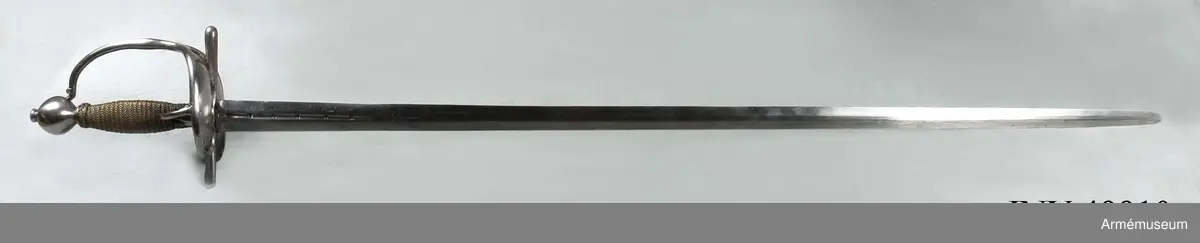
Group D II. Karolinsk Rider’s Ship of the Normal Type. In use 1680-1740 approx. The length of the pair rod is 160 mm. The width of the ring at the top is 32 mm. The ring is twisted with flat ridges and on top of where side is provided with a blood stripe, in whose bottom XNXNXN is housed. On the inner side below the pair plate, a P-stamp is wrapped. At the end of the blood ring, the clinging is adorned by an ornament, formed by wrapped dots. The bracket is of draban type and of polished steel. The button is slightly pear-shaped, with spines in front and back. The diameter sideways is 35.5 mm, but over the spines 33.8 mm. The height is 40 mm. At the top there is a low rivet button, and down the button is continued by a very short neck. Both the rivet button and the neck have the shape of inverse, mutilated brackets. The chafer is coil shaped. In front, it has a flat stripe. The sides are rounded. Up and down, the cavity is surrounded by an approximately 8 mm wide, flat braiding, “wreath,” of apparently originally tended brass wire, which is joined by two parties. Otherwise, it is wrapped with twisted, probably originally tended brass wire of three different types, first with narrow threads, each of these twin twins and both threads twisted in the same direction, after which a slightly grassy and a rough thread, one joined by two right-wing and the other by two left-wing parties. The parerpole has lace oval cross section, is straight and becomes towards the rounded ends wider. The largest width is on the front arm of the parer- rod 12.7 mm, but on the rear 12 mm. The greatest thickness is on the front arm 10 mm, but on the back 8.6 mm. The distance from the front edge to the front pair bar arm end is 73 mm, between the rear edge and the end of the rear arm 55 mm. The edges of the cordial are raised and are really formed by buckles, one on each side. At the bars, the brackets and at the handcar, the slightly cupped pareplates are soldered with copper. The distance between the centre of the clinging and the outer edge of the parerplate is 53 mm and between the centre of the clinging and the inner edge of the parerplate is 49.5 mm. From the cross, the hand jumper, which has an elliptical cross-section with the largest width small above the tip of the parerplate, starts. The upper end of the handhouse is housed in a hole on the button. From the cross on the upper side a 22 mm high heel, with an elliptical cross section and a maximum diameter of 25 mm. This heel forms the bottom of the gable. From the inner edge of the parerplate, a bow thumb runs to the upper edge of this heel. On the outer side of the rear arm of the parerpole, the figure 3 is wrapped. In the 1879 reversal, the weapon is called “Values, Infantry, Swedish, 1690 Subofficers.” Baljan came from “Baljor, side rifles, miscellaneous leather.” In 1813 years of inventory there is a “Values, Infantry Under Officers 1690 years,” another “Värja, Under Officers 1690 years.” In 1780 years of inventory there is a “Underofficer’s Shield with a Steel Bracket” and in 1759 years of inventory “Rider Welders with Polished Fästen, pcs. 3” (see AM 1932: 7634). In Artillerimuseum’s Inventories, the coat of arms 1879-1911 is referred to as “Heat with a pound m/1690 for sub-officers at the infantry.” In the 1912 inventory, the hoist is called “Worse with pods m/1685 with blank polished attachment, seemingly intended for officer or under- officer.” In the 1914 print catalog, the designation is only “Heat with pods m/1685 with blank polished bracket,” but on the attached catalog folder, which was from the same time, there was the addition “for the cavalry.”Von Schreeb considered that this weapon was a sub-officer’s sweater. The associated number is 49910-11, a rider’s hoist, a pointer.
Sign in to order prints, canvas, and more of this work. Browsing and full-resolution downloads stay free.