Studsmen
Unknown artist
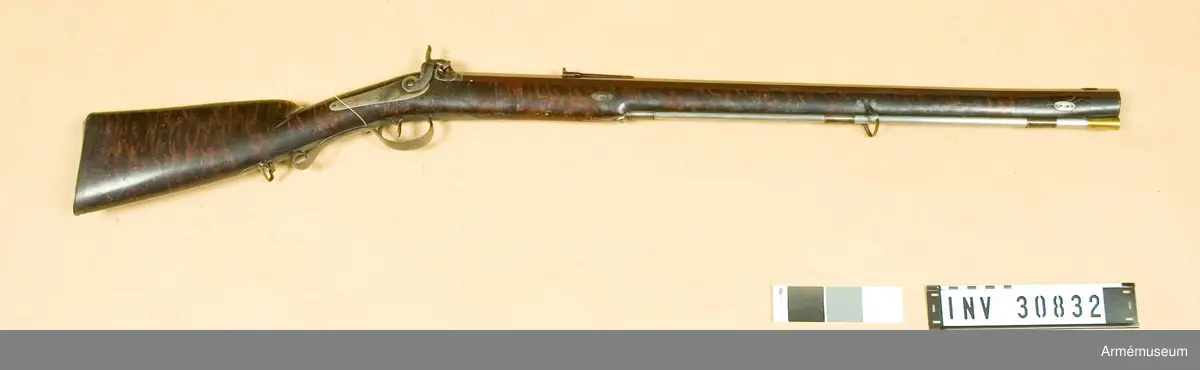
The associated number is 30832-3, bouncer, screwdriver. Group E II C. Number of ribs 8 pcs. Raffle rise: 3/4 turns on the barrel length. The barrel is steep earth, octagonal and has reinforced trump. It has a patent tail screw, which in the barrel is quite long. The rill of the tail screw has a smaller diameter than the caliber of the pipe, which is why the tail screw at the front gets a sharp edge. On the backplane, the tail screw has a hook, which is to be hooked in the tail iron recess. The barley is of silver and sits on an iron foot, which is flaxed in the barrel 23 mm behind the mouth. The sieve sits 13.5 cm in front of the tail screw and is a so-called “spring sight.” The distance division is engraved but lacks figures. The sieve foot is flaxed in the barrel. The side runner is lost. On the underside of the pipe are two booklets for the pipe controls and one for the front belt panel screw. The booms are slightly beveled at the mouth. The lock is a rearward-facing “chain lock,” i.e. the end of the upper arm of the stroke spring and the nut sleeve joined by a link. The trigger is made up of a screw placed on the trigger board so called “French snake print,” the screw of which has a sharp joint, of a hole broken through the head. As usual on snow locks, the nut has “players,” which should prevent the bar tooth from sliding into the half span hook at firing (see Enander, Advice to the handgun’s knowledge, care and attitude, p. 75 and p 131). The front of the lower arm of the impact spring is trained to rod spring. The lock now does not want to stand in full span. The tail iron has on the right side a firescreen. It is restrained at the front by the top crusader screw, at the rear by a coming screw from the trigger, which is however now interrupted. The coat is of birch and dark brownish. On the left side of the piston the cheek support. The seizure is made of blued iron. The baking sheet is restrained by two screws and has a narrow, over the carbon back inset arm. The hook has the front hook, which is hacked in a hole on the trigger board. The rear is extended to a “hand rest” and the rear is restrained by the screw of the rear belt panel, which is a wooden screw and passes through a hole in the rear extension of the rearmost belt. The sideboard has the same shape as the lockboard. The trough-shaped and along each edge there are a few raised stripes. The tip of the piping is distinguished from the actual piping by a kind of heel. Either tube restraints the barrel from the bottom of the barrel inserted screw. The blister is 35 mm long and is restrained by two from the bottom of the barrel incoming screws. The barrel is restrained in the log on the one hand by two controls, on the other hand by the screw of the front belt panel. Both the controls and the screw go in shoved holes. Each such shoe is restrained by two wooden screws. The bars have along the middle a narrow recess, in which one of the pins in the front frame runs and obstructs, that the rule is completely removed from the log. The charger is of steel and quite thick. At the lower end it has a threaded hole for the crater. The barn is on the outside shot with brass. The shock surface has a shallow recess for the ball. The bouncer is not intended for bayonet. In the reversal of the model hall, the weapon was one of two “Studsmen with flint locks, miscellaneous projections.”Out-label: Studsare FM/1839 for the army sharpshooters. Caliber 17.5 mm Kulvikt-gr Loppets. rel. long 44 cal. Starting speed -m/sek.J.Alm 1941.On the underside of the barrel there are two booklets for the pipers and one for the front strip building shadow. The beams are slightly chamfered at the mouth. The lock is a reversed “chain lock,” i.e. the end of the upper arm of the stroke spring and the nut is joined by a link. The trigger is made up of a print on the trigger board placed so-called “French pressure.”, the screw of which has a circular shape, of a hole pierced head. As an apprentice on snailerelås hr the nut “player,” which is to prevent the bar tooth from sliding into the half span hook at the firing (see Enandder, Instructions to the handguns knowledge, care and attitude, p. 75 and p. 131).
Sign in to order prints, canvas, and more of this work. Browsing and full-resolution downloads stay free.